📊 Nature of Roots (Very Important)
We use the discriminant:
👉 Based on value of D:
- D > 0 → Two different real roots
- D = 0 → Two equal roots
- D < 0 → No real roots (imaginary)
🔍 Example 1:
👉
✔️ Roots are equal
👉 Answer:
🔍 Example 2:
👉
❌ No real roots
✔️ Imaginary roots
📈 Graph Concept (Parabola)
👉 Every quadratic equation forms a U-shaped graph
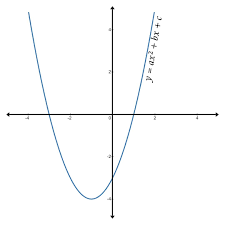
- Opens upward if
- Opens downward if
⭐ Vertex Formula (Very Useful)
👉 This gives the turning point of the graph
🎯 Word Problem Example:
The product of two numbers is 12 and their sum is 7. Find the numbers.
👉 Form equation:
✔️ Numbers are 3 and 4
🧠 Practice Questions:
- Find vertex of
Learn quadratic equations step-by-step with easy methods, formula, and solved examples for students.
Leave a Reply