Meta Description: Learn compound interest with full explanation, formulas, examples, shortcuts, and practice questions. Best maths guide for students.
Introduction
Compound Interest (CI) is one of the most important topics in mathematics and real life. It is widely used in:
- Bank savings
- Fixed deposits
- Loans and EMIs
- Business investments
Unlike Simple Interest, compound interest grows faster because interest is added to the principal again and again.
In this lesson, you will learn:
- What is Compound Interest
- Important formulas
- Step-by-step examples
- Tricks and shortcuts
- Real-life applications
What is Compound Interest?
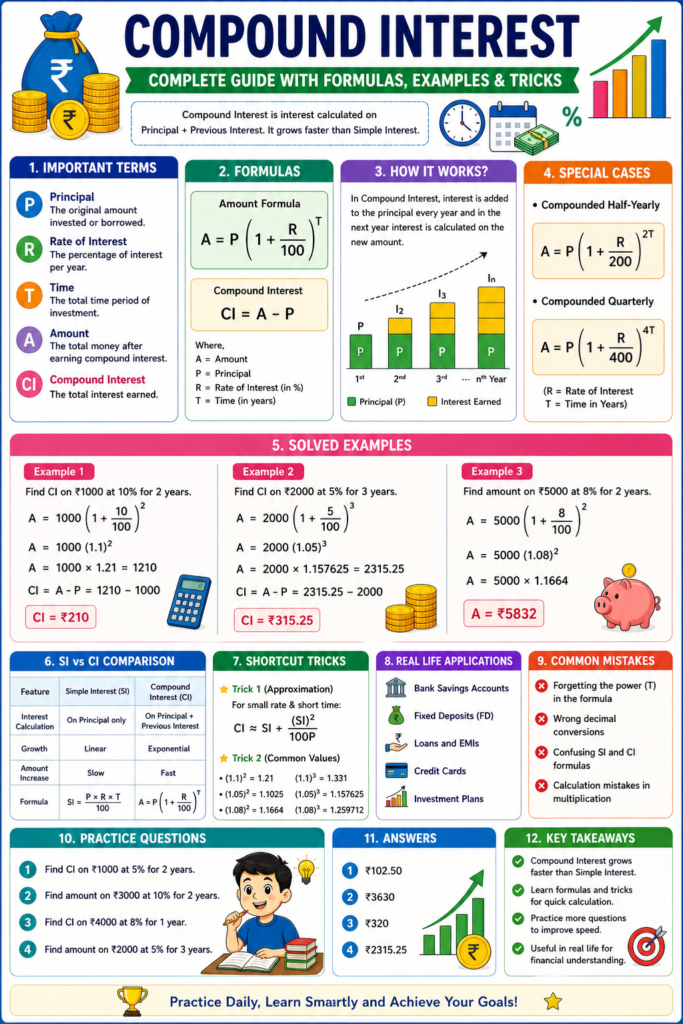
Compound Interest means interest calculated on principal + previous interest.
👉 This is why it is also called “interest on interest.”
Compound interest is the process of earning “interest on interest,” which makes money grow faster than simple interest. It is calculated using the formula , where the accumulated amount includes both the principal and the interest earned over time.
🔑 Key Concepts of Compound Interest
- Principal (P): The initial amount invested or borrowed.
- Rate (r): Annual interest rate (in decimal form).
- Compounding frequency (n): How often interest is added (yearly, quarterly, monthly, daily).
- Time (t): Number of years.
- Amount (A): Final value after compounding.
- Compound Interest (CI): .
📊Important Formula
- If compounded annually:
- If compounded monthly:
- If compounded daily:
🧮 Example Calculations
- Annual Compounding
- , , ,
- CI = ₹2,100
- Monthly Compounding
- , , ,
- CI = ₹23,102.04
📈 Why Compound Interest Matters
- Faster Growth: Each period’s interest is added to the principal, so the base keeps increasing.
- Wealth Building: Essential in savings accounts, fixed deposits, mutual funds, and retirement planning.
- Loans & Debt: Works against borrowers—credit card debt grows quickly due to compounding.
- Rule of 72: Quick trick to estimate doubling time. Divide 72 by the interest rate.
- Example: At 12% interest, money doubles in ~6 years
Growth Comparison: SI vs CI
| Simple Interest | Compound Interest |
|---|---|
| Interest on principal only | Interest on principal + interest |
| Linear growth | Exponential growth |
| Slower increase | Faster increase |
Special Case: Compounded Half-Yearly
If interest is calculated twice a year:
- Rate becomes =R/2
- Time becomes =2T
Formula
Special Case: Compounded Quarterly
- Rate = R/4
- Time = 4T
Shortcut Tricks
Trick 1
For small rates & short time:
CI=SI+ (SI)2/ 100P
Trick 2
Memorize common values:
- (1.1)² = 1.21
- (1.05)² = 1.1025
- (1.05)³ ≈ 1.1576
📌 Real-Life Applications
- Banking & Finance: Savings accounts, fixed deposits, recurring deposits.
- Investments: Mutual funds, stocks, bonds.
- Economics: Population growth, inflation, depreciation.
⚠️ Risks & Considerations
- Debt Trap: High-interest loans (like credit cards) can spiral due to compounding.
- Inflation Impact: Returns must outpace inflation to preserve purchasing power.
- Compounding Frequency: More frequent compounding → faster growth, but also higher debt burden.
Practice Questions
- Find CI on ₹1000 at 5% for 2 years
- Find amount on ₹3000 at 10% for 2 years
- Find CI on ₹4000 at 8% for 1 year
- Find amount on ₹2000 at 5% for 3 years
Answers
- ₹102.50
- ₹3630
- ₹320
- ₹2315.25
Common Mistakes
- Forgetting power (T) in formula
- Wrong decimal conversion
- Confusing SI and CI
- Calculation errors in multiplication
Conclusion
Compound Interest is a very important topic for students and real-life financial understanding. It helps you understand how money grows over time.
Practice regularly and focus on formulas to master this topic.
SEO Keywords
compound interest formula, CI examples, compound interest tricks, SI vs CI difference, banking maths, maths for students, finance maths guide.
Leave a Reply