Blog

  • Latest Science News 2026: Top Breakthroughs Changing Our Future

    📌 Meta Description

    Discover the latest science news in 2026, including space discoveries, AI breakthroughs, medical innovations, and climate updates shaping our future.

    Introduction

    Science is moving faster than ever in 2026. From space discoveries to artificial intelligence and medical breakthroughs, new developments are shaping the future of humanity. In this article, we explore the latest science news and current events that are making global headlines.


    🚀 Space Discoveries and Astronomy Updates

    1. Signs of Ancient Life on Mars

    Scientists working with NASA’s Mars rover have discovered complex organic molecules on Mars. These molecules are similar to the building blocks of life on Earth. While this does not confirm life, it strongly suggests that Mars may have supported life in the past.

    2. Understanding the Milky Way’s Edge

    Astronomers have made new discoveries about the size of our galaxy. Recent research suggests that the edge of the Milky Way may be closer than scientists previously believed. This changes how we understand our place in the universe.

    3. Progress in Quantum Teleportation

    Scientists have successfully teleported a photon over a significant distance. This breakthrough could lead to the development of a quantum internet, which would be faster and more secure than current communication systems.


    🧠 Artificial Intelligence and Technology

    AI Discovering New Scientific Laws

    Artificial intelligence is now helping scientists discover hidden patterns in complex systems like plasma. This could lead to the discovery of entirely new physical laws and improve our understanding of the universe.

    Artificial Neurons and Brain Technology

    Researchers have developed artificial neurons that can communicate with human brain cells. This could revolutionize treatments for neurological disorders and lead to advanced brain-computer interfaces.

    Ultra-Fast Imaging Technology

    New imaging tools can capture events happening in trillionths of a second. This allows scientists to study atomic and molecular processes in real time.


    🌍 Climate Change and Environmental Science

    Threat to Atlantic Ocean Currents

    Scientists warn that a major ocean current system may weaken or collapse faster than expected. This could lead to serious climate changes, including extreme weather, rising sea levels, and temperature shifts.

    Increasing Environmental Challenges

    Global warming continues to cause more frequent droughts, floods, and heatwaves. Researchers emphasize the need for urgent action to reduce environmental damage.


    🧬 Medical Breakthroughs and Health Innovations

    Gene Therapy Success

    New gene therapies are showing promising results in treating genetic diseases such as blindness and hearing loss. These treatments could soon become widely available.

    Early Cancer Detection

    Scientists are developing a single blood test that can detect more than 50 types of cancer before symptoms appear. Early detection can significantly improve survival rates.

    Longevity Research

    Researchers are using AI and biotechnology to study aging and extend human lifespan. This field is growing rapidly and could transform healthcare in the future.

    🦕 Ancient Discoveries

    Giant Prehistoric Snake Found

    Scientists have discovered fossils of a massive prehistoric snake believed to be over 50 feet long. This discovery provides new insights into Earth’s ancient ecosystems.


    📊 Why These Scientific Developments Matter

    These breakthroughs highlight major trends in science:

    • Rapid advancement of artificial intelligence
    • Increased focus on space exploration
    • Shift toward preventive healthcare
    • Growing urgency around climate change

    Together, these developments will shape the future of our planet and human life.


    Conclusion

    The latest science news in 2026 shows how innovation is transforming our world. From exploring distant planets to improving human health, science continues to push boundaries and create new possibilities. Staying updated with these discoveries helps us understand the future and our role in it.


    🔍 SEO Keywords

    latest science news 2026, current science events, science breakthroughs, AI in science, space discoveries, medical innovations, climate change news
  • Speed Time Distance Formula with Examples – Easy Maths Guide

    Meta Description: Learn speed, time and distance formulas with easy examples, tricks, and practice questions. Best beginner maths guide for students.

    Introduction

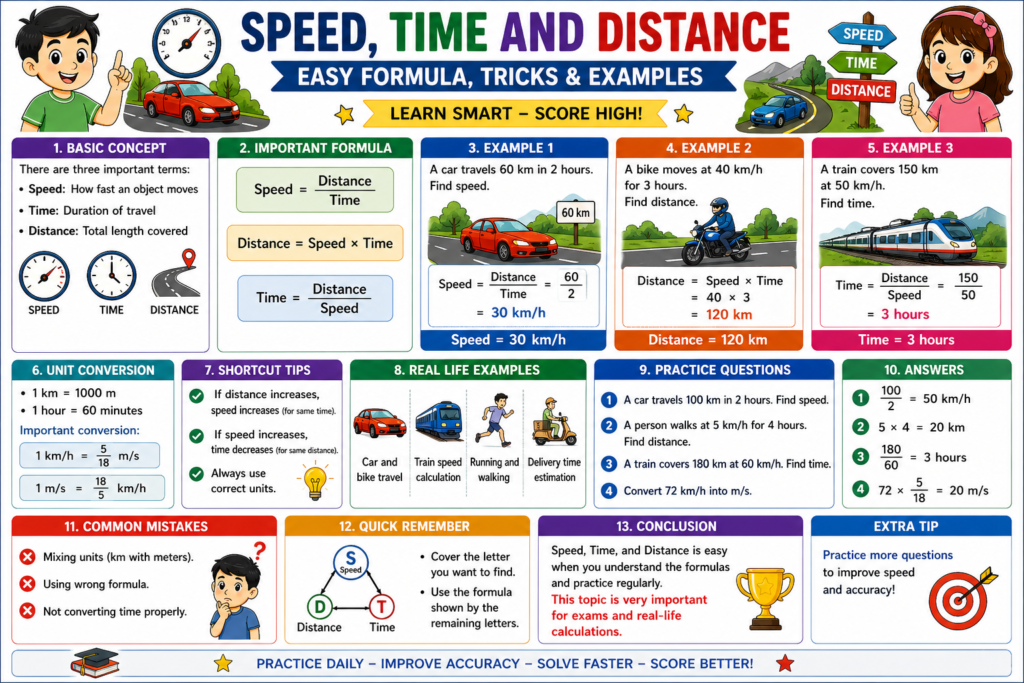
    Speed, Time, and Distance is an important maths topic used in daily life and exams. It helps us calculate how fast something moves, how long it takes, and how far it travels.

    In this lesson, you will learn this topic in a simple and easy way.

    Basic Concept

    There are three important terms:

    • Speed: How fast an object moves
    • Time: Duration of travel
    • Distance: Total length covered

    Important Formula

    From this:

    1. Speed = Distance / Time
    2. Distance = Speed x Time
    3. Time = Distance / Speed

    Example 1

    A car travels 60 km in 2 hours. Find speed.

    We know that : D= 60 km , T= 2 hours

    Speed = Distance / Time (apply formula)

    = 60/ 2

    Speed = 30 km/h

    Example 2

    A bike moves at 40 km/h for 3 hours. Find distance.

    We know that : S= 40 km/h, T= 3 hours

    Distance = Speed x Time

    = 40 x 3

    Distance = 120 km

    Example 3

    A train covers 150 km at 50 km/h. Find time.

    we know that : D = 150 km , S= 50 km/h

    Time = Distance / Speed

    = 150 / 50

    Time = 3 hours

    Unit Conversion

    • 1 km = 1000 m
    • 1 hour = 60 minutes

    Important conversion:

    1. 1 km/h = 5/18 m/s
    2. 1 m/s = 18/5 km/h

    Shortcut Tips

    • If distance increases, speed increases (for same time)
    • If speed increases, time decreases (for same distance)
    • Always use correct units

    Real Life Examples

    • Car and bike travel
    • Train speed calculation
    • Running and walking
    • Delivery time estimation

    Practice Questions

    1. A car travels 100 km in 2 hours. Find speed.
    2. A person walks at 5 km/h for 4 hours. Find distance.
    3. A train covers 180 km at 60 km/h. Find time.
    4. Convert 72 km/h into m/s.

    Answers

    1. 50 km/h
    2. 20 km
    3. 3 hours
    4. 20 m/s

    Common Mistakes

    • Mixing units (km with meters)
    • Using wrong formula
    • Not converting time properly

    Conclusion

    Speed, Time, and Distance is easy when you understand the formulas and practice regularly. This topic is very important for exams and real-life calculations.

    SEO Keywords

    speed time distance formula, speed distance time problems, maths speed time distance, easy maths formulas, student maths guide, motion maths basics.

  • Current Affairs in Technology 2026: How They Are Shaping Our Future

    Meta Description:
    Discover the latest current affairs in technology for 2026, including AI, robotics, quantum computing, cybersecurity, and how these innovations are shaping our future.

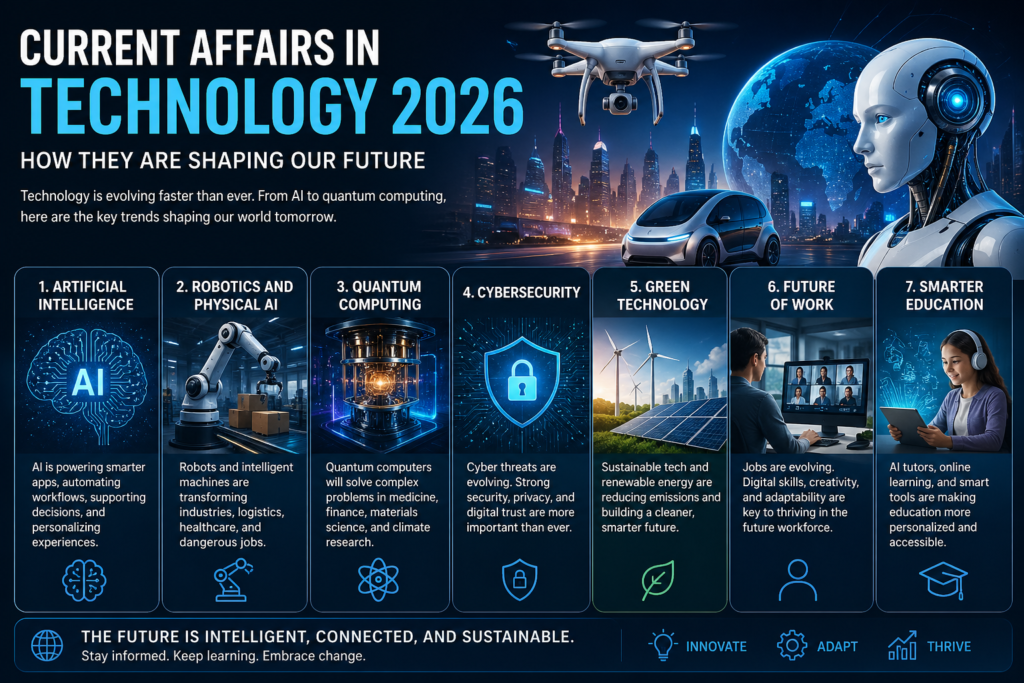
    Current affairs in technology show that we are entering a period where breakthroughs are no longer limited to labs—they are rapidly changing business, education, healthcare, jobs, and daily life. The biggest story in 2026 is the convergence of AI, robotics, quantum computing, cybersecurity, and sustainable tech. These trends are shaping our future in powerful ways.

    1. Artificial Intelligence Is Becoming More Useful

    AI is moving beyond chatbots into “agentic AI,” where systems can perform tasks, automate workflows, write code, analyze data, and support decision-making. Companies are embedding AI into productivity tools, search engines, customer service, and healthcare systems.

    How it shapes our future:

    • Faster work and improved productivity
    • Personalized learning for students
    • Better medical diagnosis and treatment planning
    • New jobs in AI management, prompt design, and ethics
    • Need for reskilling workers whose routine jobs may change

    2. Robotics and “Physical AI” Are Rising

    Technology leaders are now focusing on “Physical AI,” meaning AI inside real-world machines such as warehouse robots, self-driving vehicles, drones, delivery bots, and surgical robots.

    Future impact:

    • Factories become smarter and more efficient
    • Dangerous jobs handled by machines
    • Elderly care and hospital assistance robots
    • Faster logistics and deliveries

    3. Quantum Computing Is Getting Closer to Reality

    Quantum computing is no longer just theory. Major companies and startups are racing to build machines that solve problems impossible for traditional computers. Uses include drug discovery, financial modeling, materials science, and logistics optimization.

    Future impact:

    • Breakthrough medicines discovered faster
    • Better batteries and clean energy materials
    • Stronger climate prediction models
    • Massive cybersecurity changes because current encryption may become vulnerable

    4. Cybersecurity Is More Important Than Ever

    As AI grows, cyberattacks are becoming more advanced. Experts warn that many attacks still succeed because of weak passwords, poor updates, and human error.

    Future impact:

    • More demand for cybersecurity jobs
    • Stronger privacy laws
    • Multi-factor authentication becoming normal
    • Businesses investing heavily in digital safety

    5. Green Technology and Sustainable Computing

    Data centers, AI systems, and devices use huge amounts of power. Companies are investing in efficient chips, renewable-powered servers, and smarter cooling systems.

    Future impact:

    • Cleaner energy usage in tech
    • More electric vehicles and smart grids
    • Lower emissions from computing infrastructure

    6. Future of Work Is Changing

    Technology is reshaping jobs rather than simply removing them. Workers who learn digital skills, AI tools, creativity, communication, and problem-solving will be in higher demand.

    Future impact:

    • Hybrid work becomes common
    • Freelancing and remote jobs increase
    • Continuous learning becomes essential

    7. Education Is Becoming Smarter

    AI tutors, adaptive learning apps, virtual labs, and online certifications are making education more accessible.

    Future impact:

    • Students learn at their own pace
    • Better access in rural areas
    • Personalized coaching for exams and careers

    Conclusion

    Current technology trends show one clear message: the future will be more intelligent, automated, connected, and skill-driven. Those who adapt, learn continuously, and use technology wisely will benefit the most. Technology is not just changing tools—it is changing how we live, learn, and work.

    Focus Keywords:

    • current affairs in technology
    • technology trends 2026
    • future technology
    • AI shaping future
    • latest tech news
    • robotics future
    • quantum computing 2026
    • cybersecurity trends
    • future of technology
    • modern technology updates

    Short URL Suggestion:
    /current-affairs-technology-future

  • Time and Work Problems Easy Method with Examples for Students

    Meta Description: Learn time and work problems easily with formulas, shortcuts, solved examples, and practice questions. Best maths guide for students.

    Introduction

    Time and Work is an important maths topic for school students and competitive exams. It helps calculate how much time a person or group takes to complete a job.

    In this lesson, you will learn time and work problems in a simple and easy method.

    What is Time and Work?

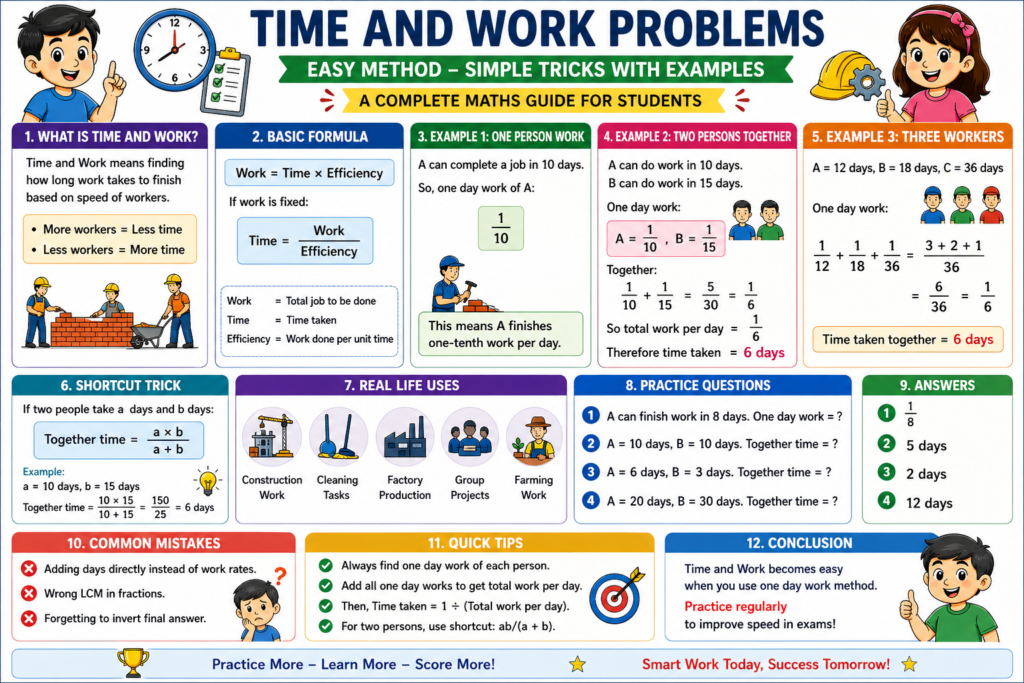
    Time and Work means finding how long work takes to finish based on speed of workers.

    Basic rule:

    • More workers = Less time
    • Less workers = More time

    Basic Formula

    Work = Time x Efficiency

    If work is fixed:

    Time=Work/EfficiencyTime=Work / Efficiency

    Work = Total job to be done

    Time = Time taken

    Efficiency = Work done per unit time.

    Example 1: One Person Work

    A can complete a job in 10 days.

    So, one day work of A: 1/10

    This means A finishes one-tenth work per day.

    Example 2: Two Persons Together

    A can do work in 10 days.
    B can do work in 15 days.

    One day work:

    A= 1/10 , B= 1/15

    Together:

    =1/10 + 1/15

    = 5/30

    = 1/6

    So total work per day =1/6

    Therefore time taken: 6 days

    Example 3: Three Workers

    A = 12 days, B = 18 days, C = 36 days

    One day work:

    A= 1/12 , B= 1/18 , C= 1/36

    =1/12 + 1/18+ 1/36

    = 3+2+1/36

    = 1/6

    Time taken together =6 days

    Shortcut Trick

    If two people take a days and b days:

    Together time =a x b/a+b

    Example: a= 10 days b=15 days

    Together time = 10 x 15 /10+15

    = 150/25

    = 6 days

    Real Life Uses

    • Construction work
    • Cleaning tasks
    • Factory production
    • Group projects
    • Farming work

    Practice Questions

    1. A can finish work in 8 days. One day work = ?
    2. A = 10 days, B = 10 days. Together time = ?
    3. A = 6 days, B = 3 days. Together time = ?
    4. A = 20 days, B = 30 days. Together time = ?

    Answers

    1. 1/81/8
    2. 5 days
    3. 2 days
    4. 12 days

    Common Mistakes

    • Adding days directly instead of work rates
    • Wrong LCM in fractions
    • Forgetting to invert final answer

    Conclusion

    Time and Work becomes easy when you use one day work method. Practice regularly to improve speed in exams.

    SEO Keywords

    time and work problems, time and work easy method, maths tricks time work, one day work formula, aptitude time and work, student maths guide.

  • Amazing Octopus Facts: The Smartest Animal in the Ocean

    The ocean is full of mysterious creatures, but one animal stands out for its intelligence and unique abilities—the octopus. Many people consider the octopus one of the smartest animals on Earth. In this blog post, we’ll explore amazing octopus facts, why they are special, and what makes them fascinating creatures.

    What Is an Octopus?

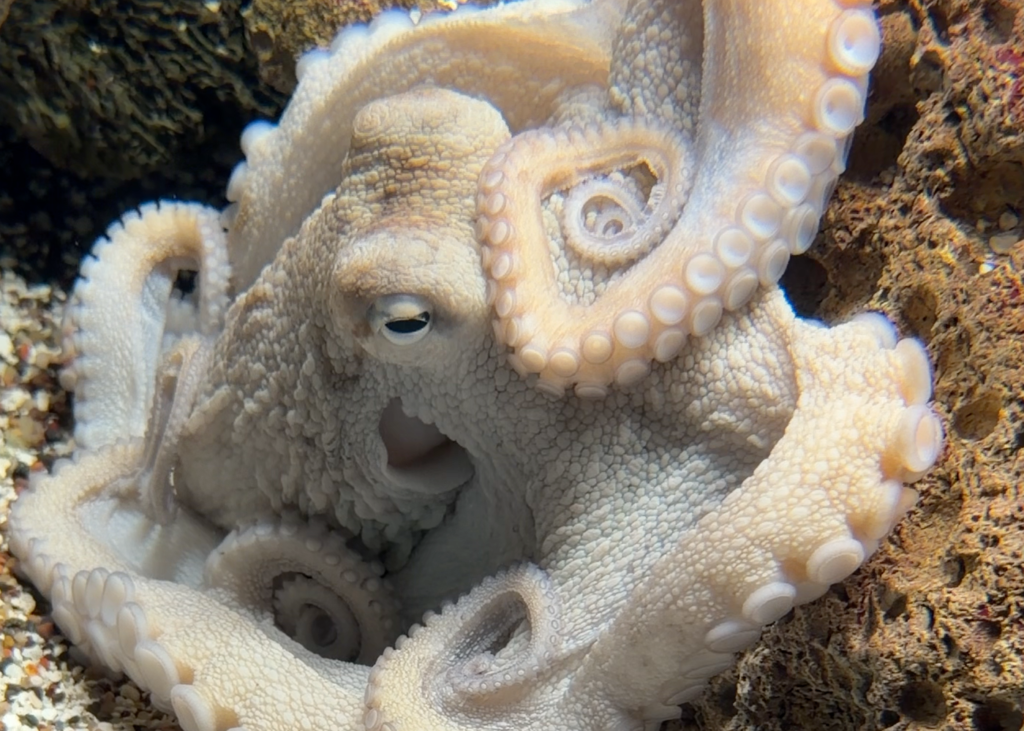
    An octopus is a sea animal with eight arms, a soft body, and no bones. It belongs to a group called mollusks, which also includes snails and clams. Octopuses live in oceans around the world, from shallow reefs to deep sea waters.

    Why Is the Octopus So Intelligent?

    Scientists have discovered that octopuses are highly intelligent animals. They can:

    • Solve puzzles
    • Open jars to get food
    • Escape from tanks
    • Recognize people
    • Learn from experience

    This makes the octopus one of the smartest invertebrates in the world.

    They’re incredibly intelligent—able to solve puzzles, open jars, and even escape enclosures. They have three hearts, blue blood, and can change both color and texture to camouflage instantly. Some species even use tools, like carrying coconut shells for shelter.

    What really stands out is how different their nervous system is: a large portion of their neurons are in their arms, meaning each arm can act semi-independently. It’s almost like they’re eight mini-brains working together.

    Amazing Octopus Facts

    1. They Have Three Hearts

    An octopus has three hearts. Two hearts pump blood to the gills, while one pumps blood to the rest of the body.

    2. Their Blood Is Blue

    Unlike humans, octopuses have blue blood because it uses copper-based hemocyanin instead of iron-based hemoglobin.

    3. They Can Change Color

    Octopuses can quickly change their skin color and texture to hide from predators or communicate.

    4. They Have No Bones

    Because they have no skeleton, octopuses can squeeze through tiny spaces.

    5. They Use Tools

    Some octopuses collect shells or coconut halves to use as shelter.

    Where Do Octopuses Live?

    Octopuses are found in oceans worldwide. They prefer rocky areas, coral reefs, and sea floors where they can hide in small caves.

    Why Are Octopuses Important?

    Octopuses are an important part of marine ecosystems. They help control populations of crabs, fish, and shellfish, while also serving as food for larger animals like sharks and dolphins.

    Fun Fact for Kids

    The plural of octopus can be octopuses or octopi, though octopuses is more commonly accepted today.

    Conclusion

    The octopus is truly one of nature’s most amazing animals. With three hearts, blue blood, and incredible intelligence, it continues to surprise scientists and animal lovers alike. If you love learning about sea life, the octopus is a creature worth exploring.

    SEO Keywords Used:

    octopus facts, intelligent animals, smartest ocean animals, octopus information, sea animal facts, octopus blog post.

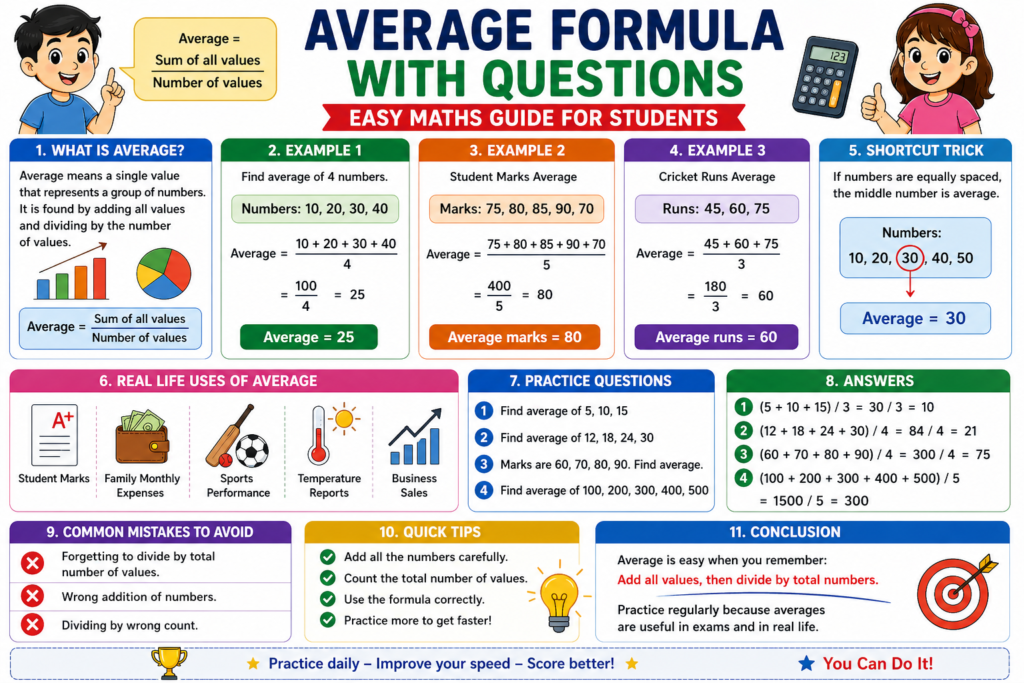
  • Average Formula with Questions – Easy Explanation for Students

    Meta Description: Learn average formula easily with solved examples, shortcuts, questions, and answers. Best beginner maths guide for students.

    Introduction

    Average is one of the most useful maths topics in school and daily life. We use averages in marks, salaries, temperatures, cricket scores, and statistics.

    In this lesson, you will learn the average formula in a simple and easy way with examples.

    What is Average?

    Average means a single value that represents a group of numbers.

    It is found by adding all values and dividing by the number of values.

    Average=Sum of all valuesNumber of values\text{Average}=\frac{\text{Sum of all values}}{\text{Number of values}}

    Example 1: Find Average of 4 Numbers

    Find average of 10, 20, 30, 40

    10+20+30+404=1004=25\frac{10+20+30+40}{4}=\frac{100}{4}=25

    Average = 25

    Example 2: Student Marks Average

    Marks scored: 75, 80, 85, 90, 70

    75+80+85+90+705=4005=80\frac{75+80+85+90+70}{5}=\frac{400}{5}=80

    Average marks = 80

    Example 3: Cricket Runs Average

    Runs scored in 3 matches: 45, 60, 75

    45+60+753=1803=60\frac{45+60+75}{3}=\frac{180}{3}=60

    Average runs = 60

    Shortcut Trick

    If numbers are equally spaced:

    10, 20, 30, 40, 50

    Middle number is average.

    Average=30\text{Average}=30

    Real Life Uses of Average

    • Student marks
    • Family monthly expenses
    • Sports performance
    • Temperature reports
    • Business sales

    Practice Questions

    1. Find average of 5, 10, 15
    2. Find average of 12, 18, 24, 30
    3. Marks are 60, 70, 80, 90. Find average.
    4. Find average of 100, 200, 300, 400, 500

    Answers

    1. 5+10+153=10\frac{5+10+15}{3}=10
    2. 12+18+24+304=21\frac{12+18+24+30}{4}=21
    3. 60+70+80+904=75\frac{60+70+80+90}{4}=75
    4. 100+200+300+400+5005=300\frac{100+200+300+400+500}{5}=300

    Common Mistakes to Avoid

    • Forgetting to divide by total number of values
    • Wrong addition of numbers
    • Dividing by wrong count

    Conclusion

    Average is easy when you remember: add all values, then divide by total numbers. Practice regularly because averages are useful in exams and real life.

    SEO Keywords

    average formula, average maths questions, how to find average, easy average examples, average for students, school maths average.

  • Current Challenges in Climate Change Initiatives (2026): Why Global Action Still Faces Roadblocks

    Climate change is one of the most urgent issues facing the world today. Governments, companies, and environmental groups have launched many initiatives to reduce carbon emissions and protect the planet. However, despite progress in renewable energy and awareness campaigns, several challenges continue to slow climate action. In 2026, the world is still struggling to balance economic growth, energy demand, and environmental responsibility.

    In this article, we explore the current challenges in climate change initiatives and why stronger global cooperation is needed now more than ever.


    1. Weak Policy Implementation

    Many countries have announced net-zero targets and carbon reduction goals. However, turning promises into action remains difficult. Some governments delay climate laws, reduce budgets, or change policies after elections.

    Without stable long-term plans, businesses and investors hesitate to support clean energy projects.

    Key Issue:

    Climate promises are increasing faster than real implementation.


    2. Dependence on Fossil Fuels

    Coal, oil, and natural gas still power industries, transport, and electricity systems in many nations. Rapidly replacing fossil fuels requires time, money, and infrastructure.

    Some countries continue to approve new oil and gas projects due to rising energy demand and global supply concerns.

    Key Issue:

    Energy security often competes with climate goals.


    3. Insufficient Climate Finance

    Developing countries need billions of dollars for renewable energy, flood protection, drought management, and green infrastructure. However, promised international climate funds often fall short.

    Poorer nations face the highest climate risks but have the fewest resources.

    Key Issue:

    Climate action is unequal without fair financing.


    4. Extreme Weather Events Rising

    Floods, heatwaves, wildfires, cyclones, and droughts are becoming more frequent and severe. Many cities are unprepared with weak drainage systems, poor emergency planning, and limited healthcare response.

    Key Issue:

    Climate impacts are growing faster than adaptation efforts.


    5. Slow Renewable Energy Expansion

    Solar and wind energy are growing rapidly, but there are obstacles such as:

    • Limited battery storage
    • Weak electricity grids
    • Delays in land approvals
    • High upfront costs
    • Supply chain shortages

    Key Issue:

    Clean energy growth must speed up to meet climate targets.


    6. Greenwashing by Companies

    Some companies advertise eco-friendly products or carbon-neutral goals without major changes to operations. This is known as greenwashing.

    It creates confusion and reduces trust among consumers.

    Key Issue:

    Real climate action needs transparency and accountability.


    7. Public Resistance to Lifestyle Changes

    People support environmental protection, but some resist changes like:

    • Higher fuel prices
    • Plastic bans
    • Public transport shifts
    • Energy-saving restrictions

    Key Issue:

    Climate policies succeed only with public support.


    8. Global Coordination Problems

    Climate change is a worldwide issue, but countries often prioritize national interests. Disagreements continue over:

    • Who should cut emissions first
    • How much each nation should pay
    • Trade rules for green products
    • Technology sharing

    Key Issue:

    No country can solve climate change alone.


    Conclusion

    The world has the technology and knowledge to fight climate change. The biggest challenge now is taking action quickly, fairly, and together. Governments, businesses, and citizens must work as one to create a cleaner and safer future.

    Climate change initiatives can succeed—but only if commitment becomes stronger than delay.


    SEO Keywords:

    current challenges in climate change initiatives, climate change problems 2026, global warming solutions, renewable energy challenges, climate action barriers, environmental issues today.

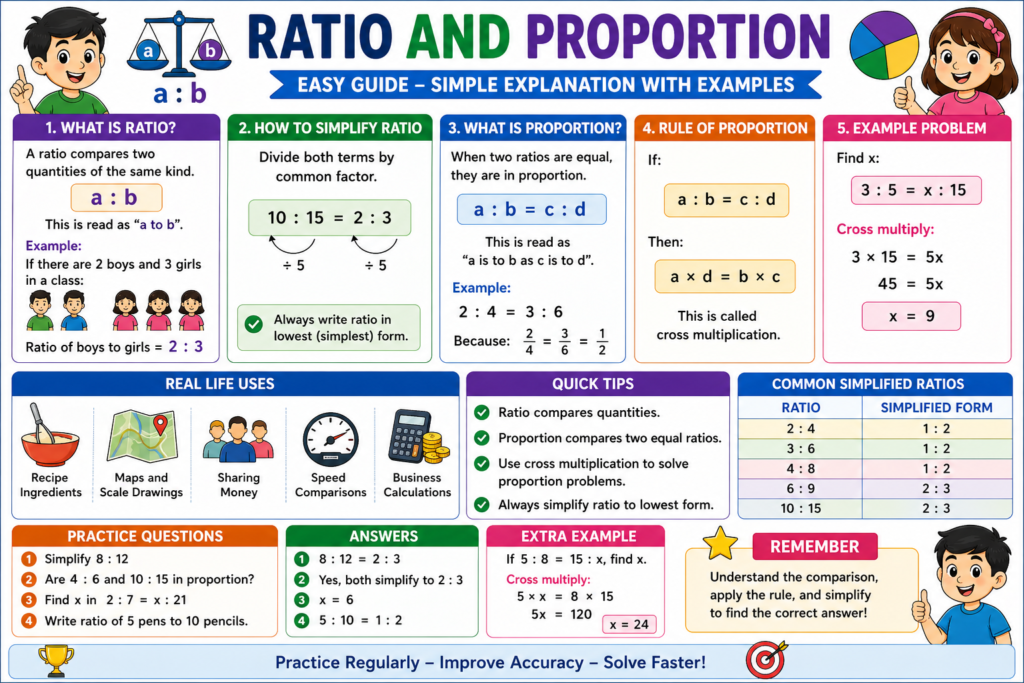
  • Ratio and Proportion Easy Guide with Examples for Students

    Meta Description: Learn ratio and proportion easily with formulas, examples, shortcuts, and practice questions. Best beginner maths guide for students.

    Introduction

    Ratio and proportion are important maths topics used in daily life, business, cooking, maps, and school exams. They help compare quantities and understand equal relationships.

    In this lesson, you will learn ratio and proportion in a simple and easy way.

    What is Ratio?

    A ratio compares two quantities of the same kind.

    a:ba:b

    This is read as a to b.

    Example:

    If there are 2 boys and 3 girls in a class:

    2:32:3

    So, ratio of boys to girls = 2:3

    How to Simplify Ratio

    Divide both terms by common factor.

    10:15=2:310:15=2:3

    (Divide by 5)

    What is Proportion?

    When two ratios are equal, they are in proportion.

    a:b=c:da:b=c:d

    This is read as a is to b as c is to d.

    Example:

    2:4=3:62:4=3:6

    Because:

    24=36=12\frac{2}{4}=\frac{3}{6}=\frac{1}{2}

    Rule of Proportion

    If:

    a:b=c:da:b=c:d

    Then:

    a×d=b×ca\times d=b\times c

    This is called cross multiplication.

    Example Problem

    Find x:

    3:5=x:153:5=x:15

    Cross multiply:

    3×15=5x3\times15=5x

    45=5x45=5x

    x=9x=9

    Real Life Uses

    • Recipe ingredients
    • Maps and scale drawings
    • Sharing money
    • Speed comparisons
    • Business calculations

    Quick Tips

    • Ratio compares quantities
    • Proportion compares two equal ratios
    • Always simplify ratio to lowest form

    Practice Questions

    1. Simplify 8:12
    2. Are 4:6 and 10:15 in proportion?
    3. Find x in 2:7=x:212:7=x:21
    4. Write ratio of 5 pens to 10 pencils.

    Answers

    1. 2:32:3
    2. Yes, both simplify to 2:32:3
    3. x=6x=6
    4. 1:21:2

    Conclusion

    Ratio and proportion are easy when you understand comparison and equality of ratios. Practice regularly to improve maths skills and problem-solving speed.

    SEO Keywords

    ratio and proportion, ratio easy guide, proportion examples, ratio maths for students, simplify ratio, ratio and proportion formulas.

  • 2026ರ ಇತ್ತೀಚಿನ ವೈಜ್ಞಾನಿಕ ಸಾಧನೆಗಳು:

    ವಿಜ್ಞಾನವು ಜಗತ್ತನ್ನು ವೇಗವಾಗಿ ಬದಲಾಯಿಸುತ್ತಿದೆ. ಪ್ರತೀ ವರ್ಷ ಹೊಸ ಸಂಶೋಧನೆಗಳು ಆರೋಗ್ಯ, ತಂತ್ರಜ್ಞಾನ, ಅಂತರಿಕ್ಷ ಮತ್ತು ಪರಿಸರ ಕ್ಷೇತ್ರಗಳಲ್ಲಿ ಮಹತ್ವದ ಬದಲಾವಣೆಗಳನ್ನು ತರುತ್ತಿವೆ. 2026ರಲ್ಲಿ ಹಲವಾರು ವೈಜ್ಞಾನಿಕ ಸಾಧನೆಗಳು ವಿಶ್ವದ ಗಮನ ಸೆಳೆದಿವೆ.

    ಈ ಬ್ಲಾಗ್ ಪೋಸ್ಟ್‌ನಲ್ಲಿ 2026ರ ಇತ್ತೀಚಿನ ವೈಜ್ಞಾನಿಕ ಸಾಧನೆಗಳು ಬಗ್ಗೆ ಸರಳ ಕನ್ನಡದಲ್ಲಿ ತಿಳಿದುಕೊಳ್ಳೋಣ.


    1. ವಿದ್ಯುತ್ ಉಳಿತಾಯ ಮಾಡುವ AI ಚಿಪ್

    ಕೃತಕ ಬುದ್ಧಿಮತ್ತೆ (AI) ಈಗ ಜೀವನದ ಅನೇಕ ಭಾಗಗಳಲ್ಲಿ ಬಳಸಲಾಗುತ್ತಿದೆ. ಆದರೆ ಇದಕ್ಕೆ ಹೆಚ್ಚಿನ ವಿದ್ಯುತ್ ಬೇಕಾಗುತ್ತದೆ. ವಿಜ್ಞಾನಿಗಳು ಈಗ ಮನುಷ್ಯ ಮೆದುಳಿನಂತೆ ಕಾರ್ಯನಿರ್ವಹಿಸುವ ಹೊಸ AI ಚಿಪ್ ಅನ್ನು ಅಭಿವೃದ್ಧಿಪಡಿಸಿದ್ದಾರೆ. ಇದು ಸುಮಾರು 70% ವಿದ್ಯುತ್ ಉಳಿತಾಯ ಮಾಡುತ್ತದೆ.

    ಇದರಿಂದ:

    • ವೇಗವಾದ ಕಂಪ್ಯೂಟರ್‌ಗಳು
    • ಪರಿಸರ ಸ್ನೇಹಿ ಡೇಟಾ ಸೆಂಟರ್‌ಗಳು
    • ಸ್ಮಾರ್ಟ್ ರೋಬೋಟ್‌ಗಳು
    • ಕಡಿಮೆ ವಿದ್ಯುತ್ ಬಳಸುವ AI ಸಾಧನಗಳು

    ಸಾಧ್ಯವಾಗುತ್ತವೆ.


    2. ಕೃತಕ ನರಕೋಶಗಳು ಮತ್ತು ಮಾನವ ಮೆದುಳು ಸಂಪರ್ಕ

    ಶೋಧಕರು ಕೃತಕ ನರಕೋಶಗಳು (Artificial Neurons) ನ್ನು ನಿರ್ಮಿಸಿದ್ದಾರೆ. ಇವು ನಿಜವಾದ ಮಾನವ ಮೆದುಳಿನ ಕೋಶಗಳ ಜೊತೆ ಸಂಪರ್ಕ ಸಾಧಿಸಬಹುದು.

    ಭವಿಷ್ಯದಲ್ಲಿ ಇದರ ಉಪಯೋಗ:

    • ಪಾರ್ಶ್ವವಾಯು ರೋಗಿಗಳಿಗೆ ಸಹಾಯ
    • ಗಾಯದಿಂದ ಚಲನೆ ಕಳೆದುಕೊಂಡವರಿಗೆ ಚಿಕಿತ್ಸೆ
    • ಮೆದುಳು ನಿಯಂತ್ರಿತ ಸಾಧನಗಳು
    • ನರ ಸಂಬಂಧಿತ ಕಾಯಿಲೆಗಳ ಚಿಕಿತ್ಸೆ

    3. ಮಂಗಳ ಗ್ರಹದಲ್ಲಿ ಜೀವದ ಅಂಶಗಳ ಪತ್ತೆ

    NASA ಯ Curiosity Rover ಮಂಗಳ ಗ್ರಹದಲ್ಲಿ ಹೊಸ ಜೈವಿಕ ಅಣುಗಳು (Organic Molecules) ಕಂಡುಹಿಡಿದಿದೆ.

    ಇದರಿಂದ:

    • ಮಂಗಳ ಗ್ರಹದಲ್ಲಿ ಹಿಂದೆ ಜೀವಕ್ಕೆ ಅನುಕೂಲಕರ ಪರಿಸ್ಥಿತಿ ಇತ್ತೇ? ಎಂಬ ಪ್ರಶ್ನೆಗೆ ಹೊಸ ಆಶೆ
    • ಭವಿಷ್ಯದ ಮಂಗಳ ಮಿಷನ್‌ಗಳಿಗೆ ಸಹಾಯ
    • ಗ್ರಹದ ಇತಿಹಾಸ ತಿಳಿಯಲು ನೆರವು

    4. Artemis II ಚಂದ್ರಯಾನ ಮಿಷನ್

    NASA ಯ Artemis II ಮಿಷನ್ ಮೂಲಕ ಅನೇಕ ವರ್ಷಗಳ ನಂತರ ಮಾನವರು ಭೂಮಿಯ ಕಕ್ಷೆ ಹೊರಗೆ ಪ್ರಯಾಣಿಸಿದರು.

    ಈ ಮಿಷನ್ ಗುರಿಗಳು:

    • ಮತ್ತೆ ಚಂದ್ರನಿಗೆ ಮಾನವರನ್ನು ಕಳುಹಿಸುವುದು
    • ಚಂದ್ರನ ಮೇಲೆ ಶಾಶ್ವತ ಕೇಂದ್ರ ನಿರ್ಮಾಣ
    • ಮಂಗಳ ಗ್ರಹ ಮಿಷನ್‌ಗೆ ಸಿದ್ಧತೆ

    5. Breakthrough Prize 2026

    ವಿಜ್ಞಾನ ಕ್ಷೇತ್ರದ “Oscars of Science” ಎಂದೇ ಕರೆಯಲ್ಪಡುವ Breakthrough Prize ಅನ್ನು ಈ ಕ್ಷೇತ್ರಗಳಲ್ಲಿ ನೀಡಲಾಯಿತು:

    • ಜೀನ್ ಥೆರಪಿ
    • ಡಾರ್ಕ್ ಮ್ಯಾಟರ್ ಸಂಶೋಧನೆ
    • ಕ್ವಾಂಟಂ ವಿಜ್ಞಾನ
    • ಕಣ ಭೌತಶಾಸ್ತ್ರ

    6. ಹವಾಮಾನ ಎಚ್ಚರಿಕೆ: ಅಟ್ಲಾಂಟಿಕ್ ಮಹಾಸಾಗರ ಪ್ರವಾಹ

    ವಿಜ್ಞಾನಿಗಳು Atlantic Ocean Current ದುರ್ಬಲವಾಗುವ ಸಾಧ್ಯತೆ ಇದೆ ಎಂದು ಎಚ್ಚರಿಕೆ ನೀಡಿದ್ದಾರೆ.

    ಇದರ ಪರಿಣಾಮ:

    • ಮಳೆ ಮಾದರಿಯಲ್ಲಿ ಬದಲಾವಣೆ
    • ಕೃಷಿಗೆ ಹೊಡೆತ
    • ಜಾಗತಿಕ ತಾಪಮಾನ ಬದಲಾವಣೆ
    • ತೀವ್ರ ಹವಾಮಾನ ಘಟನೆಗಳು

    7. ಮಾನವರಿಗೆ ಹಂದಿಯ ಅಂಗಾಂಗ ಪ್ರತಿರೋಪಣ

    ವೈದ್ಯರು ಹಂದಿಯ ಅಂಗಾಂಗಗಳನ್ನು ಮಾನವರಿಗೆ ಪ್ರತಿರೋಪಿಸುವ ವಿಧಾನದಲ್ಲಿ ಪ್ರಗತಿ ಸಾಧಿಸುತ್ತಿದ್ದಾರೆ. ಇದನ್ನು Xenotransplantation ಎನ್ನುತ್ತಾರೆ.

    ಇದರ ಪ್ರಯೋಜನ:

    • ಅಂಗಾಂಗ ಕೊರತೆ ನಿವಾರಣೆ
    • ಹೆಚ್ಚು ಜೀವ ಉಳಿಸುವುದು
    • ರೋಗಿಗಳಿಗೆ ಬೇಗ ಚಿಕಿತ್ಸೆ

    ವೈಜ್ಞಾನಿಕ ಸಾಧನೆಗಳು ಯಾಕೆ ಮುಖ್ಯ?

    ವಿಜ್ಞಾನವು ನಮ್ಮ ಜೀವನವನ್ನು ಉತ್ತಮಗೊಳಿಸುತ್ತದೆ. ಉತ್ತಮ ಚಿಕಿತ್ಸೆ, ಸ್ವಚ್ಛ ಇಂಧನ, ಹೊಸ ತಂತ್ರಜ್ಞಾನ ಮತ್ತು ವಿಶ್ವದ ಬಗ್ಗೆ ಆಳವಾದ ಅರಿವು ಕೊಡುತ್ತದೆ.

    ಇದು ವಿದ್ಯಾರ್ಥಿಗಳಿಗೆ ಉಪಯುಕ್ತ:

    • UPSC
    • KPSC
    • SSC
    • ಬ್ಯಾಂಕಿಂಗ್ ಪರೀಕ್ಷೆಗಳು
    • ಶಾಲಾ ಪ್ರಾಜೆಕ್ಟ್‌ಗಳು
    • ಸಾಮಾನ್ಯ ಜ್ಞಾನ

    ಪ್ರಮುಖ ಪ್ರಶ್ನೆಗಳು

    1. ಮಂಗಳ ಗ್ರಹದಲ್ಲಿ ಜೈವಿಕ ಅಣುಗಳನ್ನು ಯಾವ Rover ಕಂಡುಹಿಡಿದಿತು?
    2. Artemis II ಮಿಷನ್ ಎಂದರೇನು?
    3. Artificial Neurons ಯಾಕೆ ಮುಖ್ಯ?
    4. Xenotransplantation ಎಂದರೇನು?
    5. Atlantic Ocean Current ಯಾಕೆ ಮುಖ್ಯ?

    ಸಮಾಪ್ತಿ

    2026ರ ಇತ್ತೀಚಿನ ವೈಜ್ಞಾನಿಕ ಸಾಧನೆಗಳು ಭವಿಷ್ಯವನ್ನು ರೂಪಿಸುತ್ತಿವೆ. AI ಚಿಪ್‌ಗಳಿಂದ ಮಂಗಳ ಗ್ರಹ ಸಂಶೋಧನೆವರೆಗೆ, ವೈದ್ಯಕೀಯ ಅದ್ಭುತಗಳಿಂದ ಹವಾಮಾನ ಅಧ್ಯಯನವರೆಗೆ ವಿಜ್ಞಾನವು ಹೊಸ ದಾರಿಗಳನ್ನು ತೆರೆದಿದೆ.

    ವಿದ್ಯಾರ್ಥಿಗಳು, ಉದ್ಯೋಗಾರ್ಥಿಗಳು ಮತ್ತು ಜಗತ್ತಿನ ಬಗ್ಗೆ ತಿಳಿಯಲು ಆಸಕ್ತರಿರುವ ಎಲ್ಲರೂ ಇಂತಹ ಕರಂಟ್ ಅಫೇರ್ಸ್ ತಿಳಿದುಕೊಳ್ಳುವುದು ಅಗತ್ಯ.


    Keywords: 2026 ವೈಜ್ಞಾನಿಕ ಸಾಧನೆಗಳು, ವಿಜ್ಞಾನ ಕರಂಟ್ ಅಫೇರ್ಸ್, ಮಂಗಳ ಗ್ರಹ ಸುದ್ದಿ, Artemis II, AI ಚಿಪ್, ವೈದ್ಯಕೀಯ ಸಂಶೋಧನೆ, ಕನ್ನಡ ಬ್ಲಾಗ್.

  • Latest Scientific Breakthroughs in 2026:

    Science is changing the world faster than ever. Every year, researchers discover new ideas that improve healthcare, technology, space exploration, and the environment. In 2026, several scientific breakthroughs have captured global attention. These discoveries are not only exciting but also important for students preparing for competitive exams and people who want to stay updated with current affairs.

    In this blog post, we will cover the latest scientific breakthroughs in 2026 in simple language.


    1. Energy-Saving AI Chip Revolution

    Artificial Intelligence is becoming a big part of our lives, but it uses a lot of electricity. Scientists have now created a new brain-inspired AI chip that can save nearly 70% of energy compared to traditional chips.

    This breakthrough can help build:

    • Faster computers
    • Eco-friendly data centers
    • Smart robots
    • Low-power AI devices

    This is an important step because future AI systems need to be both powerful and energy efficient.


    2. Artificial Neurons Connect With Brain Cells

    Researchers have developed artificial neurons that can communicate with real human brain cells. This could become life-changing technology for people suffering from paralysis or nerve damage.

    Possible future uses include:

    • Restoring movement after injuries
    • Helping stroke patients
    • Brain-controlled devices
    • Better treatments for neurological diseases

    This discovery combines biology and technology in a powerful way.


    3. Organic Molecules Discovered on Mars

    NASA’s Curiosity rover found new organic molecules on Mars. Organic molecules are important because they are linked to the building blocks of life.

    This does not mean life has been found on Mars, but it suggests Mars may once have had conditions suitable for living organisms.

    Why this matters:

    • Supports future Mars missions
    • Helps scientists understand Mars history
    • Increases hope of finding past microbial life

    Mars remains one of the most exciting planets for space research.


    4. Artemis II Moon Mission

    NASA launched Artemis II, a historic mission carrying astronauts beyond Earth orbit for the first time in many years.

    The mission is part of NASA’s plan to:

    • Return humans to the Moon
    • Build long-term lunar bases
    • Prepare future missions to Mars

    This mission marks a new era in space exploration.


    5. Breakthrough Prize 2026

    The famous Breakthrough Prize, often called the “Oscars of Science,” rewarded major achievements in:

    • Gene therapy
    • Dark matter research
    • Particle physics
    • Quantum science

    These awards celebrate scientists whose work can change the future of humanity.


    6. Climate Warning: Atlantic Ocean Current

    Scientists released a warning that the Atlantic Ocean circulation system may weaken significantly in the coming decades.

    This could affect:

    • Rainfall patterns
    • Agriculture
    • Global temperatures
    • Extreme weather events

    Climate science remains one of the most urgent areas of research.


    7. Pig Organs for Human Transplants

    Doctors are making progress in using pig organs for human transplantation. This process is called xenotransplantation.

    Benefits may include:

    • Solving organ shortages
    • Saving more lives
    • Faster treatment for patients waiting for transplants

    Though still developing, this breakthrough could transform modern medicine.


    Why Scientific Breakthroughs Matter

    Scientific discoveries improve everyday life. They bring better medicine, cleaner energy, advanced technology, and deeper knowledge about our universe.

    For students, these topics are useful for:

    • UPSC
    • SSC
    • Banking exams
    • KPSC
    • School projects
    • General knowledge preparation

    Important Questions for Current Affairs

    1. Which rover found organic molecules on Mars in 2026?
    2. What is Artemis II mission?
    3. Why are artificial neurons important?
    4. What is xenotransplantation?
    5. Why is the Atlantic Ocean current important?

    Conclusion

    The latest scientific breakthroughs in 2026 show how innovation continues to shape the future. From AI chips to Mars discoveries and medical miracles, science is helping solve global challenges and opening new possibilities.

    Staying updated with scientific current affairs is important for students, job aspirants, and anyone curious about the world.


    Keywords: latest scientific breakthroughs 2026, science current affairs, Mars discovery, Artemis II, AI chip news, medical science updates, current affairs science blog.